Thursday, April 25, 2013

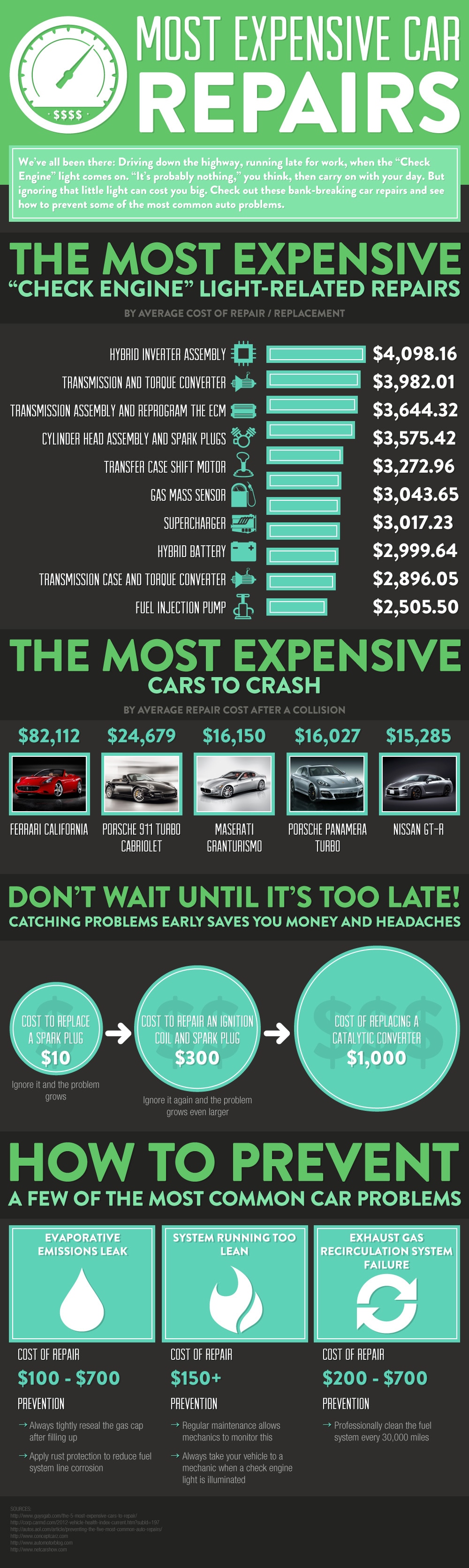
Why You Shouldn't Ignore Your Check Engine Light: An Infographic


Every driver eventually has to deal with a pesky engine light; it’s such a universal problem that once it flickers on it almost seems common practice among drivers to ignore the light as long as possible, thinking that it’s a false alarm or a minor problem.

But ignoring that annoying little light on your dash can actually lead to bigger costs when you finally get your car repaired. Don’t believe us? Check out this great infographic to find out which repairs related to a flashing check engine light could cost you the most – and what you can do to prevent problems in the first place.

Click here to view a bigger image!


Thursday, April 18, 2013

Seven Summertime Auto Myths Debunked

With summertime just around the corner, many drivers are probably ready to get in gear (no pun intended) and hit the road. Roadtrips and weekend getaways are both popular things to do in our freetime.

Of course, both require keeping your car in working order, and doing this can be tricky because of the number of myths that seem to float around year after year about summer car care. To help know what advice is sound and which to ignore, we recommend checking out this blog post from Popularmechanics.com, which dives into the most common summer car care myths:

Seven Summertime Auto Myths Debunked

The added heat of summer driving places a strain on your car's cooling and electrical systems. Batteries don't live as long in high underhood temps, and the extra heat and pressure places a strain on hoses and belts. High speeds and hot pavement are also tough on tires and brakes. These are all good reasons to give your vehicle a good checkup before leaving on that vacation road trip, starting with checking the tire pressures and all the fluids. But are there good ways to prevent overheating (not you—the car)? Do you really need antifreeze in your radiator all summer? Should you use heavier oil? There are plenty of old wives' tales, advice from distant relatives and just plain weird stuff you read on the Internet that confuse drivers. Here are some real facts about summertime and your car.

Learn how to care for your car properly this summer by reading the full Seven Summertime Auto Myths Debunked article on Popularmechanics.com.

Thursday, April 11, 2013

Tips For Driving Safely This Spring


The worst of winter’s hazardous driving conditions may finally be behind us, but don’t let that fool you! There are still plenty of things drivers need to watch for on the road. Here are a few things drivers should keep in mind as they begin their journey into the spring season.

●      Monitor evening temperatures. If you live in an area that still has some snow, be prepared to deal with possible icy patches. Especially if that snow melts during the day and refreezes at night!
●      The end of winter means the end of hibernation for a number of animals. Be ready to watch for an increase in the number of critters trying to cross the road.
●      Warmer weather means an increase in the number of cyclists and motorcycle riders on the road! Be cautious and triple-check your blind spots to avoid an accident
●      Fluctuation in temperature during the changing seasons means road deterioration! Be vigilant. Focus on your driving, keep your eyes high, and be careful when it rains: the water can mask just how deep any potholes may be.

Check out Esurance’s page for more information on how to drive safely during the spring: http://www.esurance.com/driving-tips/spring-driving

Thursday, April 4, 2013

What’s a Hemi and do you need one?


If you turned on the television in the early 2000’s you probably remember all of those Chrysler commercials about having a “Hemi”. And if you’re anything like the rest of us, you probably sat there wondering what the heck a hemi is and whether or not you need one?

A hemi is a type of engine. It is an internal combustion engine whose cylinder’s roofs are of hemispherical shape (hence “hemi”) as opposed to the normal flathead engine. One of the benefits of having a hemi is that the area of the combustion chamber (the part of the engine where the fuel is burned) is smaller than a flathead engine’s. With less surface area, there is less space for fuel to spread out and cool off, ultimately keeping the gas at its optimal combustion temperature and providing for better gas economy. In addition to the smaller surface area, a shape of a hemi allows for larger valve size. Larger valve’s allow for a more fluent control of air and liquid mixtures, allowing for a smoother performance.

All of this sounds really great, but do you need a hemi? Well, not necessarily. Modern technology has allowed for smaller fuel tanks, so there is less worry about fuel not burning at optimal temperature. Additionally, as it turns out, having more valves is more efficient than larger valves. Unfortunately, if more valves were put on a hemi, because of the hemi’s shape they would stick out at crazy angles that would not be efficient for an engine.

Friday, March 29, 2013

The Heart of Your Car


What is the difference between a 4 and 6 cylinder engine and what are the benefits of each?

A car has an engine which converts fuel into a forward motion. In a 4-cylinder engine, a car has 4 pistons that rise and fall which, through a series of events, ultimately drives the car forward. A 6-cylinder engine has 6 of these pistons that rise and fall. In the most simple terms, the more pistons a car has, the more powerful the car is. A 6-cylinder engine, which is usually found in larger cars, small SUV’s and small trucks, is, in theory, 50% more powerful than a 4-cylinder engine. And an 8-cylinder engine, which is usually found in standard trucks and SUV’s, is, in theory, 100% more powerful than a 4-cylinder engine (We will come back to the “in theory” part after the explanation of the benefits).

The benefit of a 4-cylinder engine is that it is normally less expensive, lighter and will get better gas mileage. However, if you’re going to be going on long commutes, up a lot of hills, or want a car that has a bit more pick-up when the gas is pressed, you want an engine that is stronger than a 4-cylinder, ie. the 6-cylinder. Going back to the equation of more cylinders = more power, if you’re going to be hauling a lot of heavy things all the time, you’re going to want to buy something with 8-cylinders, like a standard truck or SUV.

Now, to touch on the “in theory” aspect. The reason why a 6-cylinder engine is “in theory” 50% more powerful than a 4-cylinder engine, and an 8-cylinder engine is “in theory” 100% more powerful is because of the advancement of technology. The advancement of technology has lead us to 4-cylinder engines that are far more powerful than they used to be, as well as 8-cylinder engines that are way more gas efficient. An 8-cylinder engine of a 2013 SUV may have better gas mileage than a 4-cylinder engine of the 1980’s, and a 6-cylinder engine of the 1980’s may be less powerful than a 4-cylinder engine of 2013.

Friday, March 22, 2013

13 Weirdest Ways to Clean Your Car

As a car owner, you want to treat your car similarly to how you would treat your own body. A car has a skeleton and an entire system of interconnecting pipes and motors that, much like your own body, you want to keep clean and running smoothly. Additionally, a car has a superficial layer that, as an owner, you want looking nice since that is generally what others will see. Besides for these two aspects, however, is a car really that much like a person? Well, according to Reader’s Digests, “13 Weird Tricks to Clean Your Car,” it might be way more like us than you would think. For instance, did you know that using hair conditioner with the ingredient lanolin to clean your car will keep it looking waxed and even repel rain water? How about the fact that a jug of cheap vodka mixed with water and liquid detergent is a way to make your own windshield wiper fluid? And we won’t even go into what they recommend you do with Maxi Pads, but you can surely check it out for yourself by clicking on the link here: 13 Weird Tricks to Clean Your Car

Friday, March 15, 2013

20 Most Interesting Facts About Cars


“All of you guys have read certain interesting facts about animals, technology, or people at least once in [your] life. Right? And since [a] car is something you use every day, this time it’ll be facts about cars. These infotaining car facts might surprise everybody, from car enthusiast[s] to simply car owner[s]. So in the name of entertainment and because car[s] [are] the most popular type of transport, [here is a] list of great facts about automobiles and things regarding autos. Accompanied with pictures that will help you get a visual description, these great facts can change your attitude towards routine work or usual stuff. Get to know [these] top 20 interesting facts about cars!”


More here:
http://blog.carid.com/20-most-interesting-facts-about-cars
Twitter Delicious Facebook Digg Stumbleupon Favorites More